ditto, +1
1 Like
Implemented in Plugin: Advanced Exclude (cross-post)
12 Likes
I made a plugin to solve this problem by batch adding or removing a dot “.” at the beginning of filenames to show/hide files, which helps avoid lag issues caused by Obsidian indexing.
Plugin name: File Ignore, now available in the plugin store.
1 Like
“Excluded files” option doesn’t quite work for me as the most annoying features of having an unwillingly indexed folder for me are not excluded from parsers
I think we need a feature request for additional functionality of “excluded files” . Not only are the files indexed, but excluded files also appear in the “move file to” dialog. Often the folder name I type into the dialog box doesn’t appear in the results because it is crowded out by what should be hidden/excluded folders.
2 posts were merged into an existing topic: Plugin:File Ignore, now available in the plugin store
Just going to add that after using Obsidian for a little bit and enjoying it, I’ve had to move away from it due to this limitation. I have notes / documentation spread across lots of different project folders, and the huge amounts of artifact files make even the simplest operations grind to a halt.
I want to create a knowledge base across all my notes and projects and have them connect, but it’s not possible to do that if the files are restricted to a specific Markdown only vault folder. So unfortunately, Obsidian, as nice as it is, does not meet my requirements.
2 Likes
+1
I am really disappointed by the Obsidian team - it’s been years now and still nothing has moved from their side.
Meanwhile, a (from my perspective) seemingly appropriate solution in form of a plugin has been rejected. What’s up there? They won’t implement this incredibly useful (and actually kind of basic!) feature themselves, but block solutions of others?
Hoping for this feature soon, Obsidian is such a nice software, but becomes unusable for a whole user group if they don’t implement this feature…
3 Likes
Guess there’s still not bite on this from the Obsidian team, It would be such a useful feature for a variety of people so I’m shocked they haven’t implemented anything like it yet
Thank you for your development!
I still regret that this feature, which should have been implemented by the official team, ultimately requires a third-party plugin. What’s even more regrettable is that this plugin can’t even be listed on Community Plugins. 
2 Likes
+1 for a .gitignore like feature in Obsidian. This would solve a bunch of challenges for me.
1 Like
I’m kinda blown away that this still isn’t a thing. I keep checking every few months just in case. This isn’t some weird random “ooh this would be a nifty new feature” corner case. It feels like core functionality for an app whose main purpose is maintaining a set of synced files between devices - especially for an app that promises “Your notes are yours - it’s just a directory of files!”
I say all this as a huge fan of Obsidian, and who gladly pays for the Sync Plus subscription, and who tells all his friends to stop using {whatever-app-you-use} and switch to Obsidian, like, yesterday.
1 Like
Man, the lack of even just simple acknowledgement of this request at any point over the 5+ years it has been repeatedly requested, all while users are here resorting to increasingly absurd workarounds like the clever one above involving overlayfs (don’t get me wrong, definitely a cool idea and craft approach - but certainly much higher up on the absurdometer than most workarounds shared on this forum), is giving me bad vibes…
The interesting part for this case is that while the request can be viewed as yet another performance issue report + fix request, its effects likely run much deeper than typical. It is clear to any user who hits this issue that the magnitude of performance degradation is obviously a direct function the number of files in the vault and total storage footprint. So, the natural and obvious workaround that users, like myself, fall back to (assuming no appetite for heroics or plugin writing) is preventative - reduce vault size, then maintain that vault size, forever, lest Obsidian’s usability degrades again. This places an effective cap on how much can be stored in a vault; a vague, ambiguous cap whose responsibility of enforcement falls onto the user, as Obsidian will degrade if they do not enforce it and will only improve once they do.
This changes how users view vaults. My original hopes were to have a master vault for everything in my digital life, dreaming of some sort of nerd nirvana where any information I may ever one day realize a need or desire to locate would be present and organized. I gave up on this path very quickly after starting down it, as once I setup something to sync my Pocket bookmarks + their extracted page contents down into markdown files Obsidian’s performance immediately and noticeably degraded. When I later bought a new machine (unrelated reasons) I didn’t even bother setting up the sync jobs that I made before giving up, all of which had proven to have no negative impact, because I no longer think of Obsidian in the same way. My perspective, and with it the degree to which I will integrate it into my digital life, have had their own caps placed on them.
This makes me feel that this is more likely (or hopefully) not just a case of the team not caring or paying attention to these requests, passively, but of active internal resistance/friction to implementing these changes, where this proves to be another instance of the not-infrequent scenario where unanticipated effects of earlier design decisions increase the complexity of implementing some number of unexpected things, so that something which contextless outside observers would/should assess as likely low effort (relative to other requests, that is - not trivializing this/anything) is anything but.
Which, interestingly, is how I wound up migrating to Obsidian in the first place. I had a long-overdue moment of clarity one day while using Standard Notes, where I needed to search a document for a string and, propelled entirely by muscle memory at that point, kicked off into the standard workflow - open a different/secondary editor, Ctrl-A Ctr-C inside SN to copy the note contents, tab to the other editor, C-V, then Ctrl-F and type the search string, see what is found, grab whatever I needed, then close the other editor and hop back to SN, finally returning home after another successful search operation. I briefly woke up from my fugue state and thought “wait, wtf was I just doing?”, searched for alternatives, downloaded Obsidian, imported my notes, and a few days later uninstalled SN. I had posted in a thread on their forum requesting in-doc searching, as I could not fathom how they could simply choose to neglect a literal base note editor primitive for so many years, and was made to realize the implementation actually did have a significant amount of additional complexity (due to things I cannot recall,) but were valid and understandable, though still nowhere near satisfying. Luckily Obsidian is the current top rung of the ladder and there is nowhere else to jump, so out the overlayfs man page comes…
I would like to thank every developer trying to come up with a plugin to fix this problem. But I don’t think that plugins start working until the obsidian completes indexing. Therefore, plugins aren’t the correct solution, unless they can be started before Obsidian and mask those folders we want to hide.
My vault cannot even start up. It gets stuck at unable to read some system folder.
Somewhat tech jargony explanation: System folder fell into Obsidian’s scope because I am on Linux, and there are few Windows games on my computer. Those Windows games expect to see C:\ and Z:\ drive where the drivers and such should be located. Result? Symbolic Links to Linux system folders in Z:\ drive with graphics drivers the games need as well as few other system stuff (executable and configuration files) that my local account is not allowed to read. This is not an issue except for Obsidian.
Solution? Delete all the games, their saves etc. to start up Obsidian. Even after I open obsidian, there is no solution. How can I configure Obsidian to disregard certain files and folders, if there is. A simple .obsidianignore file is all we need.
UPDATE: Hiding folder via `.hidden` doesn’t help, but hiding it by turning it into a DOT file or directory does.
Fun fact: even if Obsidian could successfully read and index those system files and continue indexing, it could potentially reach my user’s folder in home folder, and to symbolic link that it caused it to go to system level. This theorically causes an infinite loop, that obsidian would have no way of getting out. And guess what: https://murtezayesil.me/resources/obsidian_memory_filled_up_during_index.png
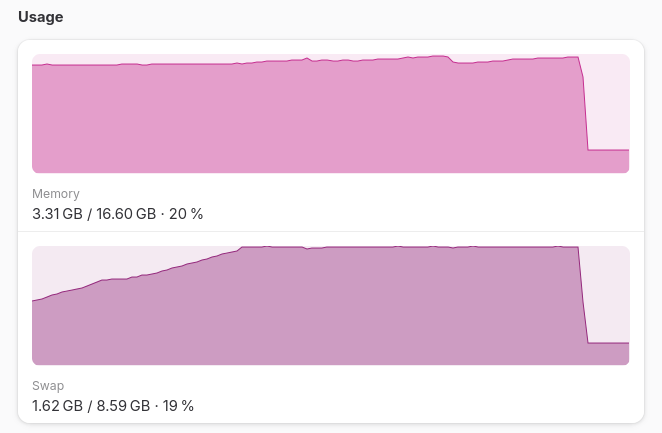
All these headaches can be avoided with .obsidianignore file that respects .gitignore scheme. But the exclusion systems in Obsidian are limited to sync and whether to show something in folder tree: Settings - Obsidian Help
1 Like
First I thought this is still a problem in 2025, but then I tried userIgnoreFilters as some recommended to Exclude files and I think it is solved for me for now.
Situation:
- I use my “~/Documents” folder on my pc as my vault. (windows user here)
- Thus my vault is ~/Documents/ and ~/Documents/.obsidian
- I have a subfolder ~/Documents/development
- My notes about development projects here
- some smaller projects are stored here (including their local git repos)
- thus some `node_modules` folders end up in my vault
- with thousands of README.md and other Markdown files I want to ingore
- it is synchronized to multiple systems - linux server, Android phone using syncthing. I excluded
node_modulesas pattern in my.stignore,
Problems
- slow startup time:
Vault (9,218 files): 5,899ms - when searching for something, the index on “find or create a note” includes the resources linked in markdown files, such as illustrative images mentioned in a README.md .
What I would love
.obsidianignore file in the root of the vault or in the .obsidian subfolder.
Solution
I found @WhiteNoise answer Config to ignore/hide select files and folders - #132 by WhiteNoise to use “Options > Files & Links > Excluded files”
I set this and it vastly improved my situation.
I do not see tons of README.md files in my “quick open” dialogue in Obsidian anymore.
My .obsidian/app.json contains now
  "userIgnoreFilters": [
    "/node_modules/"
  ]
1 Like
Hello!
There are numbers of Feature Requests and Discord messages on this topic. As this request is the one with (it seems) the highest number of likes and comments, would OP consider merging arguments and benefits described in other FR/comments/messages in the original message to sort of summarize everything in one place for both the Obsidian team, but also all community members who look for this so they find this post, and can all send love for this request in one central place?
I gave a first try at drafting what it could look like on /t/faded-files/110052.
Let me know if I can be of help!
1 Like
Just moving content from the other FR here, so the other is just about renaming the setting.
Use case or problem
Excluded file is a confusing term for many.
- A lot of us would actually want to have a way to ignore files or a folder from being indexed, but would still be able to have them available as embed or show up in a Base.
- Frequently, that one folder with assets and large files would greatly improve performance opening and browsing Obsidian if ignored.
- This would also allow us to have our images and such directly available without having to find our own sync solution for a second folder, setting up web servers on our phones, or complete homelab / dedicated production servers.
I believe it would be understandable that ignored folders are not sync by Obsidian sync, nor published, but that’s a side conversation.
Proposed solution
The first step would be to rename the current setting to… Something else. Open debate at /t/rename-excluded-files/110052.
Later on, a second step would be to introduce a “Ignored files” setting.
Ignored file would be not indexed, not read on vault opening, not anything. Obsidian just bypass them. Until the file is embedded, or read by a plugin.
Current workaround
To ignore files, we currently have to store them out of the vault, and setup complex environments to access them from within our vaults. Several external sync tools, web servers, cross platform solutions, homelab or dedicated servers. You name it!
Or otherwise, the other choice we have is to… Not ignore them. Have 20k items in our vault, 17k being images, icons, resource files. This introduce number of other problems.
What gets solved & Related feature requests
- Gets ride of the confusions and assumptions around the Excluded files term.
- /t/ignored-folder-not-really-ignored/47542
- Number of Discord messages. “I thought excluding a folder would”
- Reduces chances to hit the 10k items limit of the suggester algorithm.
- /t/…quick-switcher-…-algorithm-above-10000-items…/56861
- Also a good chunk of Discord messages. “not index specific folder”, “remove from quick switcher”
- Let people have files available to be embedded or used by plugin without polluting the Files (Explorer), Quick Switch, Search, …
- A few Discord messages as well. “exclude from base”, “my vault is 94% disk size attachments”, “any way to exclude images from the quick switcher“
- Better performances for large vault, especially on mobile.
- I know there’s upcoming work on this going on (as written in the roadmap), but I believe that would help anyway?
If you have other good reasons, related FR, or want to suggest an edit to this post, please comment here or ping me on Discord (DM accepted).
2 Likes
Some of my vaults contain a bunch of git-repositories and therefore a lot of small files in .git. Would it be possible to a .obsidianignore file to the vault in which if can specify which files I would like to ignore during loading? And also not showing these files/folders in the folder structure within obsidian? Then i could just add **/.git/ to the .obsidianignore file and everything would be fine. 
Use case or problem
Large vaults with many small files load forever. E.g. with many git repos.
Proposed solution
Add a .obsidianignore file to the vault where we specify which files/folder should be ignored.
Current workaround (optional)
No i guess?
Thanks for you work!
Regards
Max
1 Like
Is NOW a time to take this feature seriously? Now, finally in the AI age where markdown is the lingua franca of AI Agents, and every software developer on the planet is racing to try to find the best way manage their markdown…? Obsidian is already a theme in harness engineering.
Do you really not see the business potential here that implementing this feature opens up?
2 Likes
Obsidian team has always gone at its own pace.
Please implement this feature, me and my team need to be able to ignore all folders not containing any .md file. Like this, full repos (software development) could be organised and documented using Obsidian, collaboration with AI Agents would profit from this as well.
Without this feature we can’t use Obsidian. Thank you!
1 Like