Taskgregator - 2.5.0 Released

Disclaimer

Is this project open source? Yes (MIT)
Is this project completely free? Yes (optional “buy me a coffee” tip, nothing gated)
Is this project vibe-coded beyond the author’s ability to comprehend how it works? No
Community Directory: Taskgregator - Obsidian Plugin

Taskgregator

Task management that works the way you already work.

Taskgregator isn’t another task system to adopt. It reads the plain markdown checkboxes you already write, wherever you already write them, and gives you fast, focused views of your work without asking you to change a thing.

No separate database. No special task files. No syntax to learn. No rules to follow. Your notes stay exactly as they are, and your tasks stay on the lines where you typed them. Taskgregator just aggregates, organizes, and surfaces them so you can see everything from different angles and act on it in place.

Think Things, Todoist, or TickTick, but pointed at the notes you already have instead of a silo you have to feed.
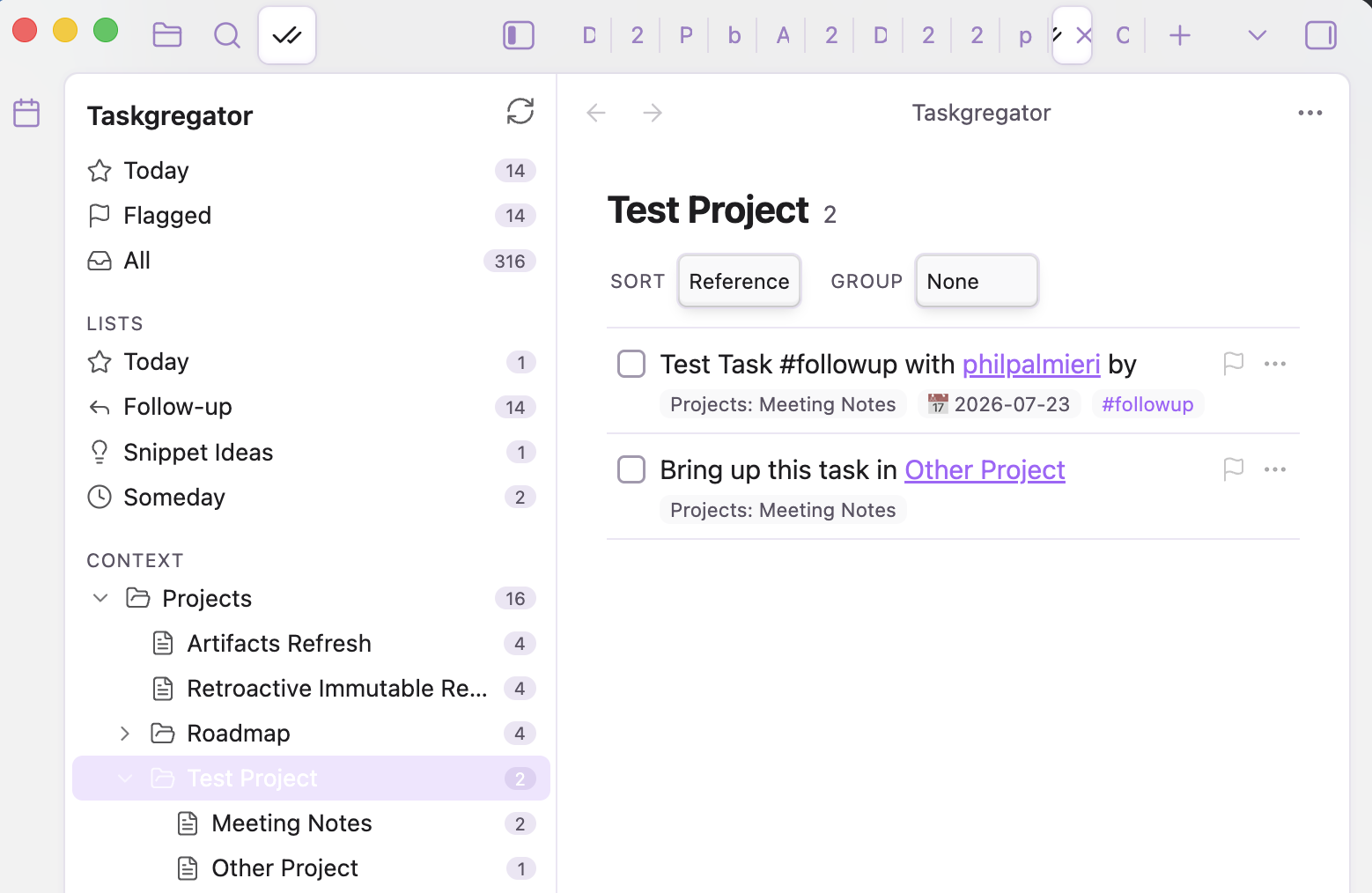
The navigator (smart lists + a roll-up tree of your context folders) on the left, and the task list for whatever you’ve selected on the right.

Why it’s different

Most task plugins make you pick a side: adopt a whole new system, or scatter each task into its own document with its own metadata block. Both make your notes serve the tool. Taskgregator flips that. The tool serves your notes.

• Zero adoption cost. A task is just a markdown checkbox. If you can write - thing , you’re already using it.
• No enforced structure. No required fields, no mandatory tags, no folder layout you must follow. Use as much or as little as you want.
• No separate store. Nothing is duplicated into a database or a task vault. The markdown line is the single source of truth, and every edit writes straight back to it.
• Context comes from where things already live. A task in Projects/Website Redesign.md belongs to that project. A task that mentions [[People/Alex]] belongs to Alex too. You don’t tag it; the location and links already say it.
• See it from any angle. The same task shows up under its project, under the people it links to, and in your date-based smart lists, all at once, with no copies to keep in sync.

Each task shows its context chip, dates, priority flag, and tags, all parsed from the plain markdown line.

A context sidebar that follows the note you’re editing

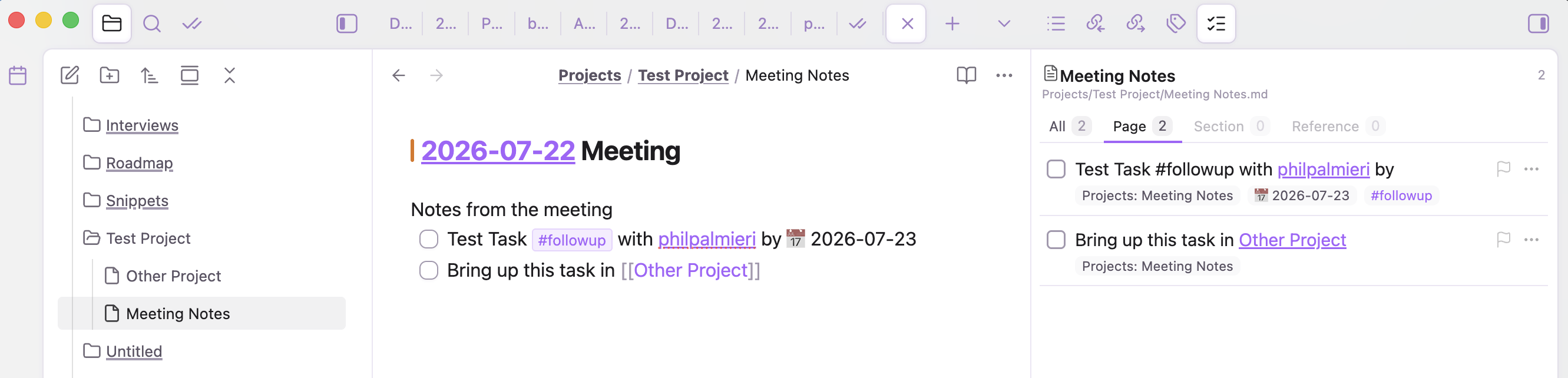
It shows that note’s tasks with Page / Section / Reference / All tabs.

Page shows the tasks written on the current note, right beside it while you work.
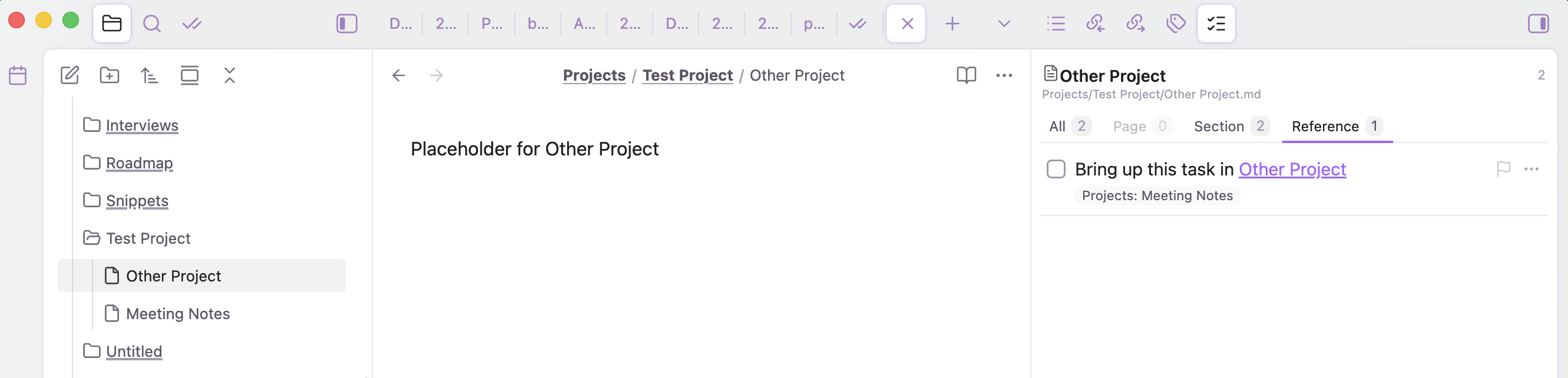
Reference shows tasks living elsewhere that link to this note, so inbound work surfaces too.
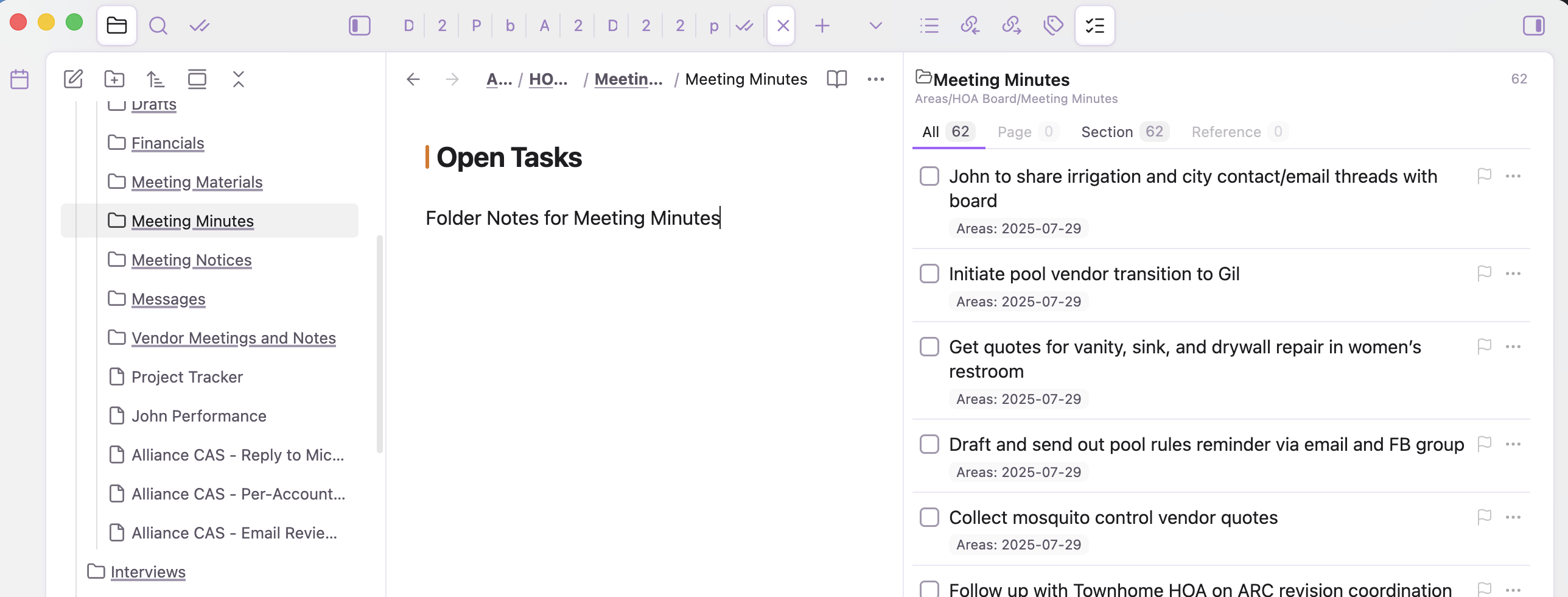
Section rolls up a whole subtree. On a folder note (a file named after its folder), you get every open task beneath it in one list.
Configurable to your vault

Pick which folders become context buckets, which behave as a flat inbox, your priority tags, smart lists, and more.

Other bits

• Smart lists driven by tags (Today, Follow-up, Someday, etc.), plus built-in Today, Flagged, and All.
• Inline editing written straight back to the original markdown line: toggle done/cancelled, cycle priority, set dates, add tags.
• Native right-click menu on task lines across your whole vault, not just inside the plugin panel.
• Per-task detail notes (sidecars) for extended context, added lazily only when you enrich a task.
• Self-contained: no runtime dependency on Dataview or the Tasks plugin. Compatible with Tasks-plugin emoji metadata (:date: :airplane_departure: :upwards_button: etc.). Works on desktop and mobile.

Feedback and bug reports welcome. I’ll keep posting future updates in this thread.

2.4.0 Release

Added

  • Overdue smart list. A dedicated Overdue list now sits at the top of the navigator with an alert-triangle icon and a red count badge, holding every visible open task whose due date is before today. It auto-hides when nothing is overdue, so it only shows up when it’s actionable.

Overdue smart list at the top of the navigator

  • Due-date filter in the context sidebar. The right-hand panel gains a subtle All · Overdue · Today · Soon filter above the scope tabs. It narrows the current scope (Page/Section/Reference) by due window, and dims windows with nothing in them. Your choice persists for the session and doesn’t reset when you switch notes or reopen the panel.

All / Overdue / Today / Soon due filter above the context sidebar tabs

Changed

  • Today means today. The Today smart list now holds only tasks due exactly today. Overdue tasks moved to their own list instead of inflating the Today count. Their red due-date chip is unchanged.
  • Sort and Group controls are now pills. The main list view swaps the two dropdowns for two aligned rows of small clickable pills, matching the context sidebar’s style.
  • Tri-state sorting. Clicking a Sort pill cycles ascending () → descending () → off, where off returns to the default priority order. Only one sort is active at a time. Group stays a single-select.

Pill-based Sort and Group controls on the main list

Also Included Pre 2.4.0

  • Dataview inline-field format support. Taskgregator reads task metadata written as Dataview inline fields ([due:: 2026-07-29], [priority:: high], [start:: ], [scheduled:: ], [completion:: ], [cancelled:: ], [repeat:: ]) in addition to the Tasks-plugin emoji signifiers (:date: :hourglass_not_done: :airplane_departure: :red_triangle_pointed_up: :fast_up_button: :upwards_button: :white_check_mark: :cross_mark: :repeat_button:). Dates, priority, recurrence, and done/cancelled state now populate from either dialect, so every smart list, filter, sort, and grouping works the same regardless of how a task was written.
  • “Task metadata format” setting [Auto, Emoji, Dataview] (default Auto). Controls the format Taskgregator writes when you set a date or priority from the right-click menus. Auto follows the Tasks plugin’s own configured format (loosely coupled by reading its saved setting), falling back to emoji when Tasks isn’t installed.
  • All Tags folder in the navigator. Under Lists there’s a collapsible All Tags folder that rolls up every task carrying a #tag, treated just like a context folder. It shows a total badge, and each tag below it has its own count. Click a tag to open a list scoped to that tag; click the folder header for the combined view. Collapse it like any other node.
  • Load Taskgregator on startup. A new setting, Load Taskgregator on startup [Disabled, Today, All, Flagged], opens the task list to the chosen view when the vault loads, so you land in your tasks instead of the last note.
  • Search box in the navigator. A search field under the title filters tasks as you type. It scopes to the current selection (a project, Today, a tag list, etc.) and shows a Searching ‘foo’ in callout on the list, with a clear action. The filter sticks when you switch to another smart list or context node, so you can search the same term across different scopes. Clear with the × in the field or Esc.
  • Tomorrow and Soon smart lists under Today. Tomorrow shows tasks due tomorrow; Soon shows tasks due within the next N days. The window is configurable via Soon window (days) (default 7).
  • Right-click context menu on task rows in the task list and context sidebar (previously only on task lines in the editor). Set priority (submenu), due/start dates, toggle #today, open the detail note, jump to source, or cancel, without leaving the panel.

New Version: 2.5.0

Feature release. Old, still-open work stops slipping through the cracks, and you can now sort by when a task was created everywhere it matters.

Added

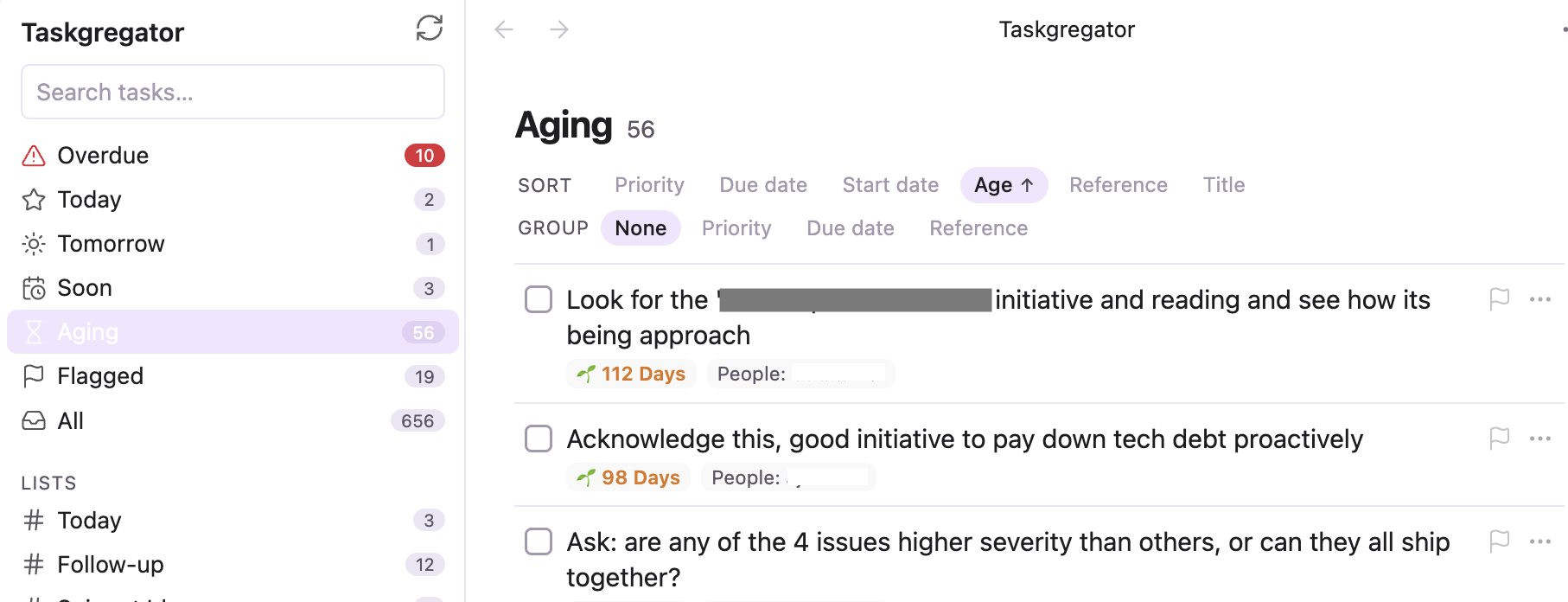
  • Aging smart list. A new Aging list sits under Soon in the navigator (hourglass icon), holding every still-open task created a configurable number of days ago or older. It surfaces stale work that’s been sitting around regardless of its due date, so nothing quietly rots. Tasks with no created date are excluded (there’s no age to measure).

  • Aging threshold setting. A new Aging threshold (days) setting controls how old a task must be to count as aging (default 14). Set it to 7 for a tighter “older than a week” view, or higher for a looser one.

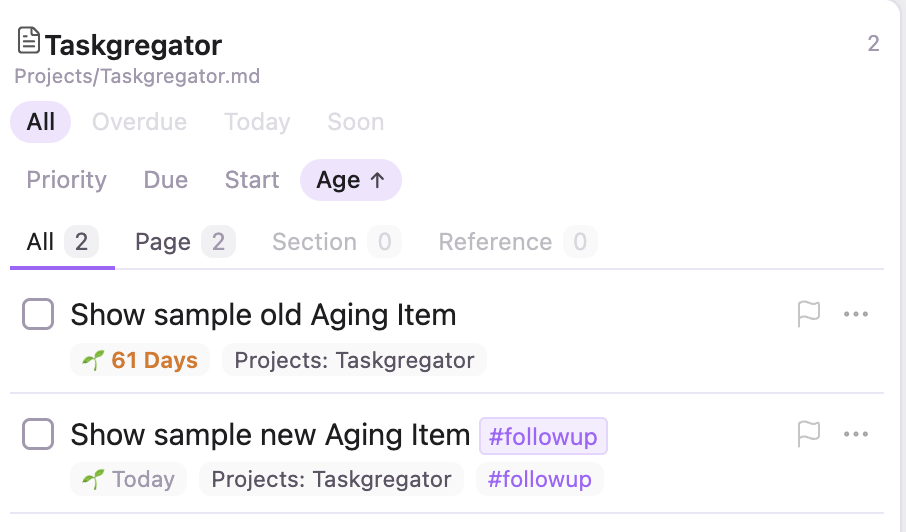
  • Sort by Created, everywhere. The main list gains an Age sort pill (by created date) alongside the existing ones, and the context sidebar gains its own tri-state sort row with Priority · Due · Start · Age, aligned with the filter and scope-tab rows. All cycle ascending () → descending () → off. Created dates are read from both the emoji and the [created:: …] Dataview inline field, so sorting works whichever format your tasks use.

  • Age chip on every task. Tasks with a created date now show a small 🌱 age chip (Today, 1 Day, 25 Days, …) in the meta row across all views. It stays a quiet grey until the task hits the aging threshold, then turns a warning color so stale work stands out at a glance.