I have a whole lot of poetry and the like where individual stanza will have explanatory foonotes, like so:
[1] Better a house, | though a hut it be,
A man is master at home;
A pair of goats | and a patched-up roof
Are better far than begging. ^36
[2] Better a house, | though a hut it be,
A man is master at home;
His heart is bleeding | who needs must beg
When food he fain would have. ^37
I will sometimes embed individual stanza in other notes by using ![[Hovalmal#^37]]. Right now, those embeds will include the number of the footnote where I’ve tagged it, but it won’t be formatted as such or include a link, it’ll just be the number in plaintext, giving me a line like “37. 37 Better a house, | though a hut it be,”.
Proposed solution
Preferably, format the footnote as you would normally, and have it link to the relevant footnote on the original page.
Alternatively, include the relevant footnote on the new page by grabbing the text of any footnotes discovered within the relevant passage, and adding them either to the new page or within the embed itself.
Alternatively-alternatively, remove the link text entirely, so that I don’t end up with the line “37. 37 Better a house, | though a hut it be,”, but instead get “37. Better a house, | though a hut it be,”.
Any of these solutions would be preferable to how it currently works, but the first would be the best since it would keep the functionality of the footnote while minimising clutter.
The manuscript has “little” in place of “a hut” in line I, but this involves an error in the initial-rhymes, and the emendation has been generally accepted. ↩︎
Lines I and 2 are abbreviated in the manuscript, but are doubtless identical with the first two lines of [[#^56|stanza 56]]. ↩︎
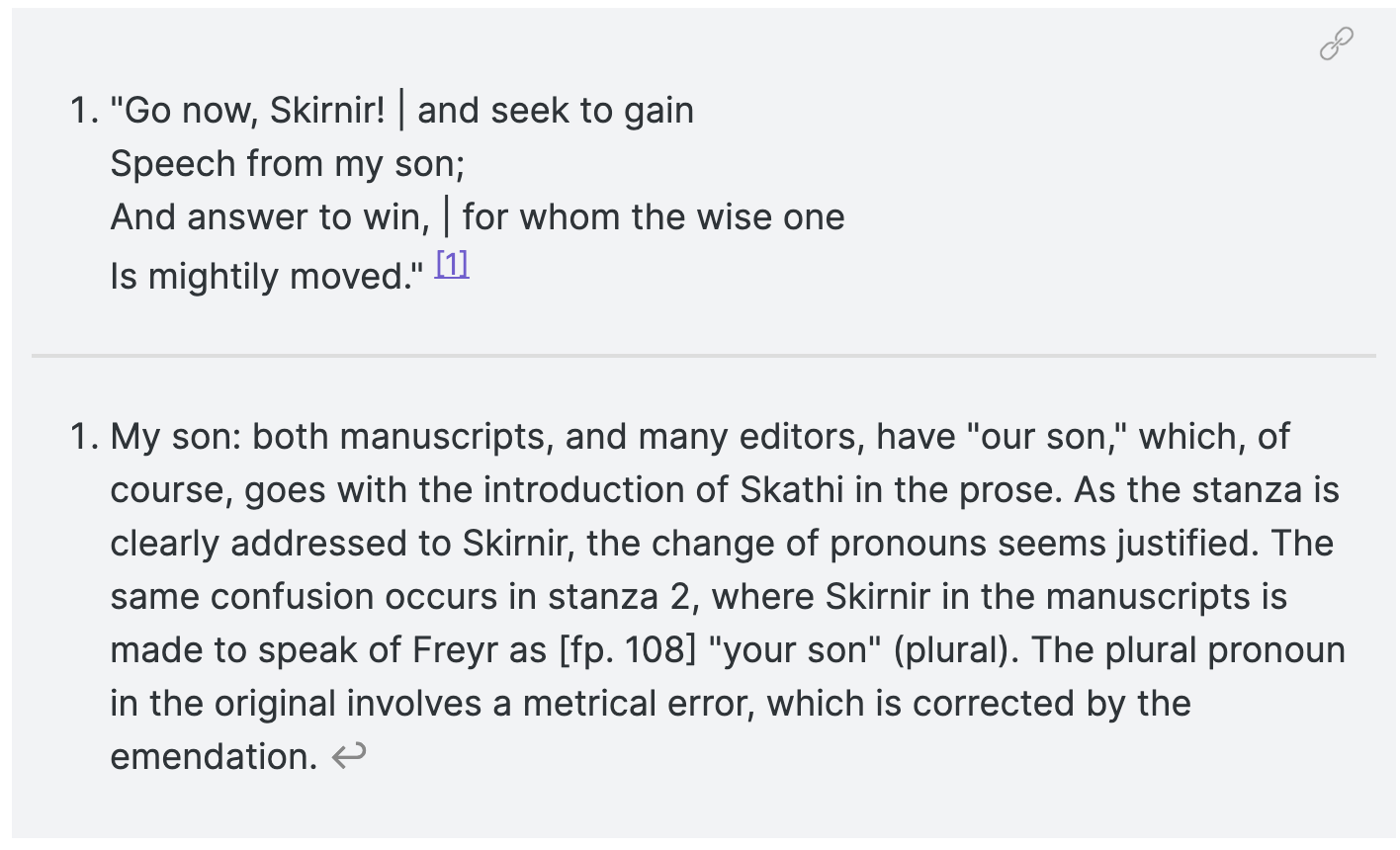
My son: both manuscripts, and many editors, have “our son,” which, of course, goes with the introduction of Skathi in the prose. As the stanza is clearly addressed to Skirnir, the change of pronouns seems justified. The same confusion occurs in stanza 2, where Skirnir in the manuscripts is made to speak of Freyr as [fp. 108]“your son” (plural). The plural pronoun in the original involves a metrical error, which is corrected by the emendation. ↩︎
Yea I would also be interested in this feature, since I’m using a lot of embedds and sometimes also footsnotes.
For now on I’ll stick to the propesd workaround of long-form footnotes.
I think all your proposed solutions are great! The “Alternatively-alternatively” solution is not 100% optimal, but it might be the quickest to implement … and a huge upgrade compared to how it is right now!
Someone got any news to this? I tried to find a way to fix it with an add-on or custom CSS, but wasn’t successful with it. So it’s still VERY annoying. Do you guys think it would be at least possible to fix with an add-on or user CSS?
the word long-form footnote he used refers to one of two types of footnotes available in obidian’s markdown syntax.
however, obsidian’s official term for them is inline footnotes and you can read about regular footnotes VS inline footnotes here: Basic formatting syntax - Obsidian Help
I have a several MD files.
At the end of them, there are several footnotes.
I’d like to collect those footnotes by embedding the footnotes only.
Firstly, I tried to put some headings just above the footnotes, but it did not work.
For example, I have [[This]] md file.
I'd like to collect the footnotes in some MD files by embedding the footnotes blocks.[^1]
But, I couldn't figure out[^2] how to do that.

# Footnotes
[^1]: This is the first footnote.
[^2]: Second footnote
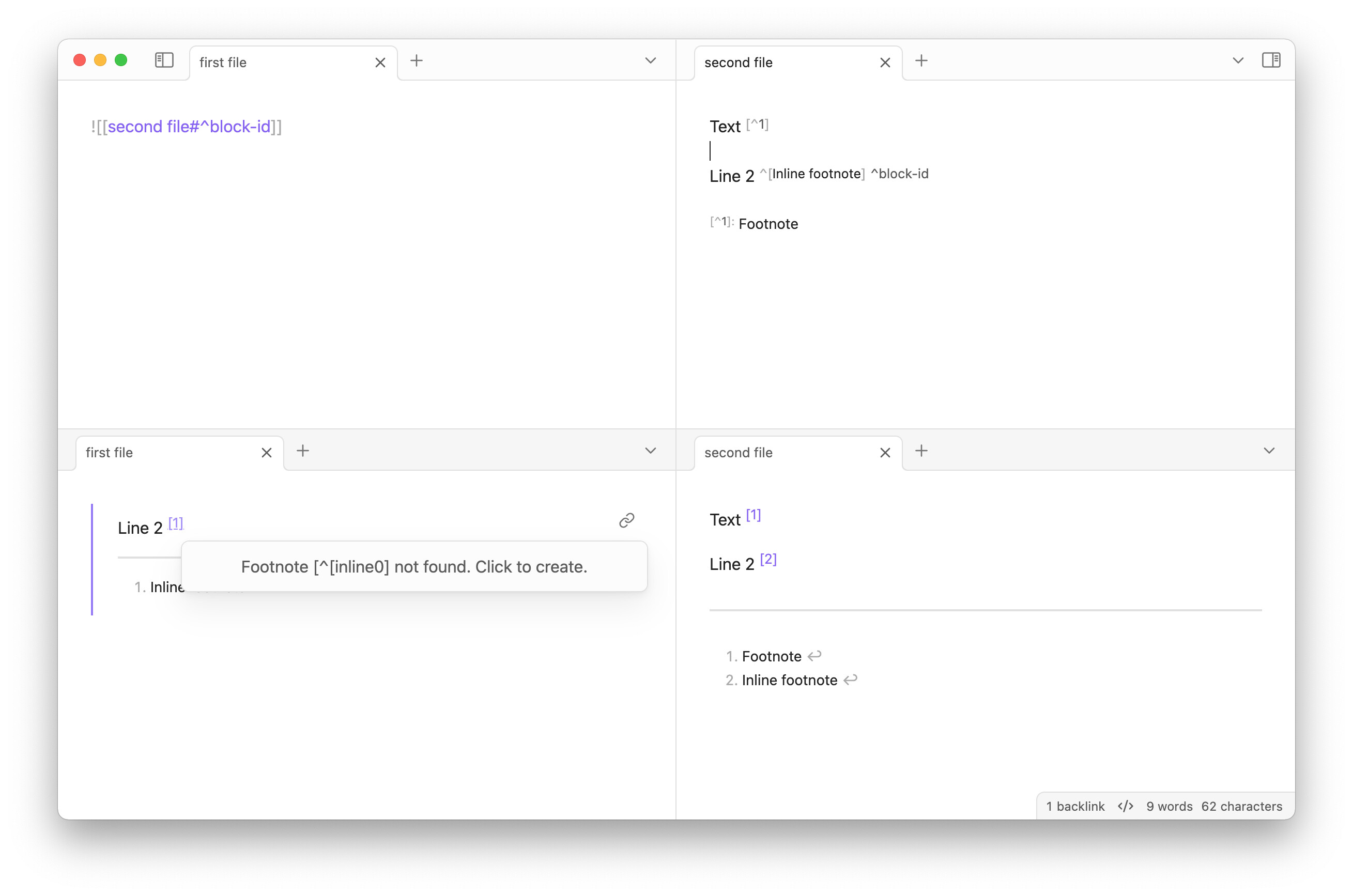
I noticed a similar problem - I was unable to transclude a single footnote by appending a ^abcdef to the end of its line. Perhaps I was just doing it wrong. But it would be nice to reference these as well.
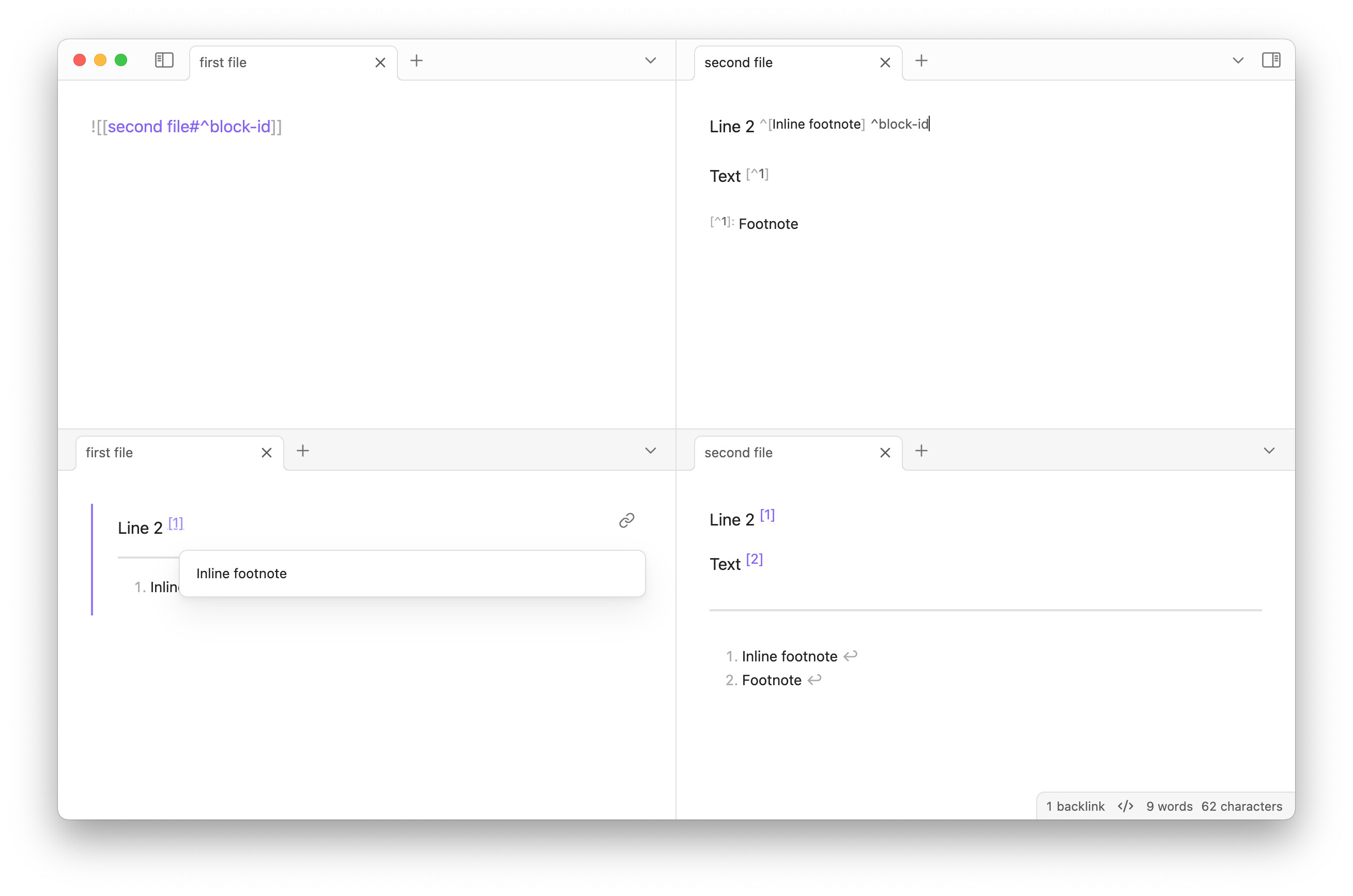
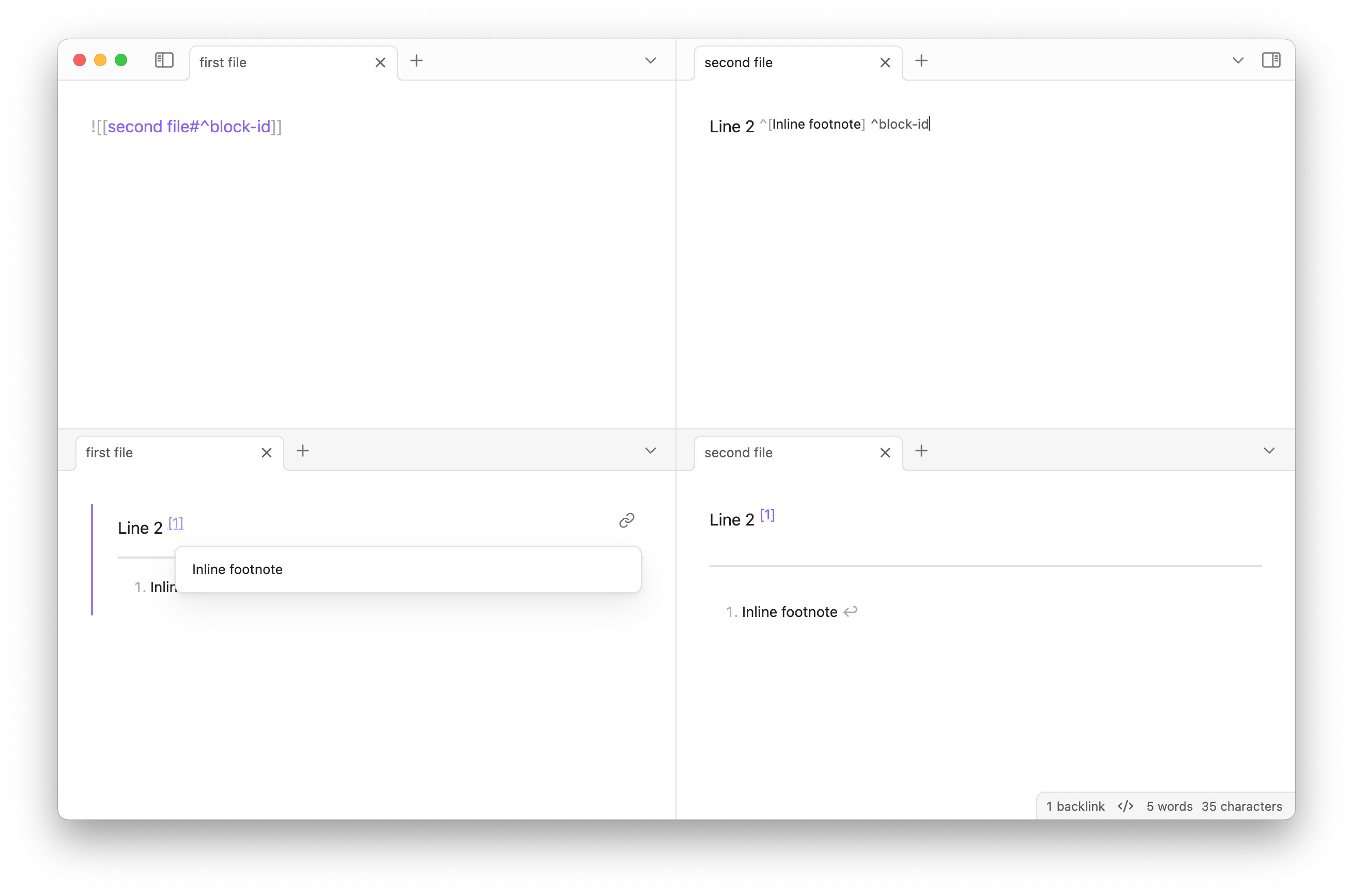
There are two markdown files needed. A file named first file and another file called second file. The folder doesn’t matter.
Create first file and paste the following content into it:
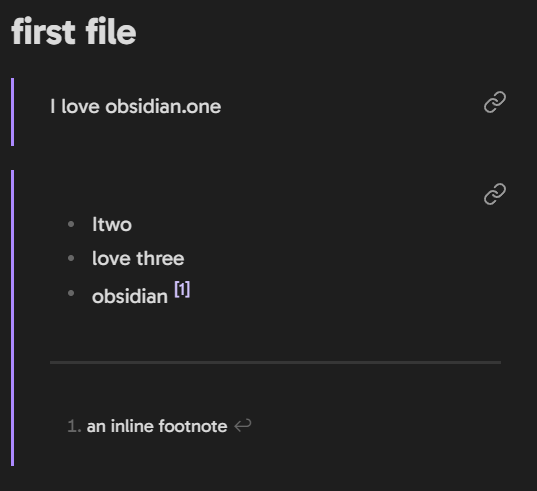
![[second file#^my-sentence-id]]

![[second file#^my-list-id]]

[^two]: this footnote exists in both files
Repeat for second file:
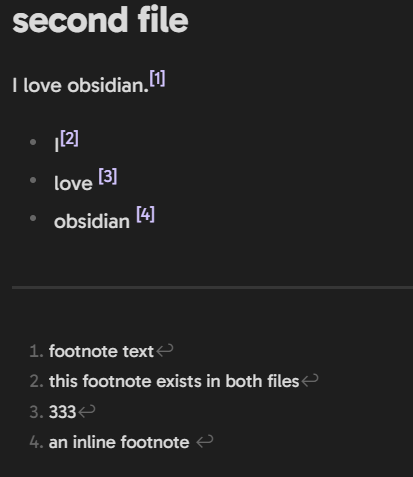
I love obsidian.[^one] ^my-sentence-id

- I[^two]
- love [^three]
- obsidian ^[an inline footnote]

^my-list-id

[^one]: footnote text
[^two]: this footnote exists in both files
[^three]: 333
You will now notice, that the footnotes of the second file are not properly displayed/rendered inside the first file. They show up as regular text.
It might be relevant to note, that footnote number two exists identically in both files.
SYSTEM INFO:
	Obsidian version: v1.4.16
	Installer version: v1.4.16
	Operating system: Windows 10 Pro 10.0.22621
	Login status: not logged in
	Insider build toggle: off
	Live preview: on
	Legacy editor: off
	Base theme: dark
	Community theme: none
	Snippets enabled: 0
	Restricted mode: on

RECOMMENDATIONS:
	none
This is probably the same bug, so I will put it here.
A footnote isn’t rendered as a footnote if it’s the line below an HTML embed. If it’s two lines below, it works. One line above, it works (but renders like it’s two lines above).
I have the same issue too and it drives me so crazy that I started to create my own plugin only to realize that generateMarkdownLink is the culprit and I need to call it anyway.