They happened in quick succession, so I want to draw attention to ariehen’s reply above yours, in case you missed it.
Discussing your second post…
The problem now is that it not just not indents “not list numbers” but it also doesn’t indent “proper list numbers” and it doesn’t look like the would be a way to distinguish those 2.
In markdown, the way to distinguish between those two is with the backslash ariehen explained.
Obsidian tries to follow (CommonMark Spec) which, like other markdown specs, essentially ordains a numbered list when it encounters numbered-list syntax. The backslash is its provision to “invisibly” escapes a bunch of its rules.
Software should do what it’s explicitly told
I agree with that frustration in so many ways! In this case, though, that syntax is an explicit instruction to create a list.
If Obsidian didn’t do something to let us know when we’ve instructed a list, then I think a lot of people would be very unhappy finding out after exporting or publishing or using a rendered view. Obsidian’s indicators inform us on the spot.
I then need to go and fight the system and apply CSS hacks to disable features I don’t like
Talking again about just this situation, no need to hack it. An escape is provided.
And a final hot take on:
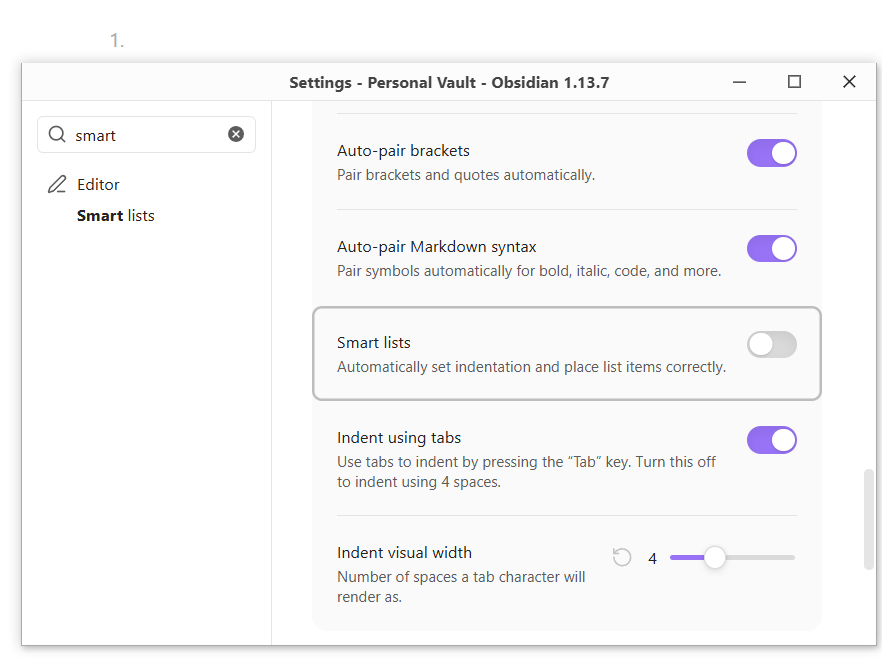
“Smart” lists, sure, add them but let people actually disable them with a single checkbox, so I can actually write 1. at the start of the line without triggering an entire list feature
I think the Smart lists setting has a confusing description. It says, “Automatically set indentation and place list items correctly.” The main change it actually effects is forcing vs allowing arbitrary numbers in our source text. That might be what’s meant by “place list items correctly”, but it’s unclear.
Turning off Smart lists lets you retain:
1. a
4. b
15. c
5. d
in your source text. Turning it on changes your source text to:
1. a
2. b
3. c
4. d
But no matter the setting, Obsidian renders list indentation and markdown-proscribed lists and numbering.