Hi folks,
I just started using obsidian and wonder which is the “best” approach to keep track of (online) courses in a second brain like approach?
To start I created a courses folder with folder course a, course b, … inside. In there I have an index file with all the couse data (author, description, category tags,…) and a file for each lesson in which I take my notes.
Now after watching some second brain implementations on youtube this kinda feels wrong to me now like I have too little links and some lessons notes content could also be an own note independent from the course.
Any thoughts on this?
Hi @_marc , thanks for posting, and welcome to the community!
I’ve found that the best advice is the one I see most often on this forum: just start writing. Don’t create folders, don’t worry much about structure; just start writing notes. One note per class seems like a good way to start, with maybe a Home note that links to each class.
As your class notes grow in size you’ll naturally want to break them into smaller notes and link to them from the class note. Over time a natural structure will emerge, and it will become clear where you want to use folders and tags – if at all!
One of the beautiful things about Obsidian is that it’s flexible enough for you to adapt the content to the way you think.
Good luck, and please keep the questions and ideas coming!
Craig
P.S.: A popular organization strategy I like is called Linking Your Thinking, but I recommend waiting to explore that link until you have at least a few dozen notes in your vault.
8 Likes
Hey Craig, thanks for you feedback and the warm welcome!
I often tend to overthink (folder) structures and love everthing perfectly in place so I guess that’s exactly the answer I needed to read!
If you’re unsure how to structure your notes in Obsidian, a great place to start is the “O” for Organize from the CODE framework, which is explained really well in this video youtube com watch?v=K-ssUVyfn5g&t=518s .
The key idea is: organize notes based on how you’ll use the information in the future, not where it came from.
For example, if multiple courses cover the same topic, it’s better to have a single note on that topic rather than separate notes for each course. This makes it easier to revise or use that knowledge later, especially when preparing for exams or projects.
Hope that helps you avoid overthinking folder structures and focus more on utility!
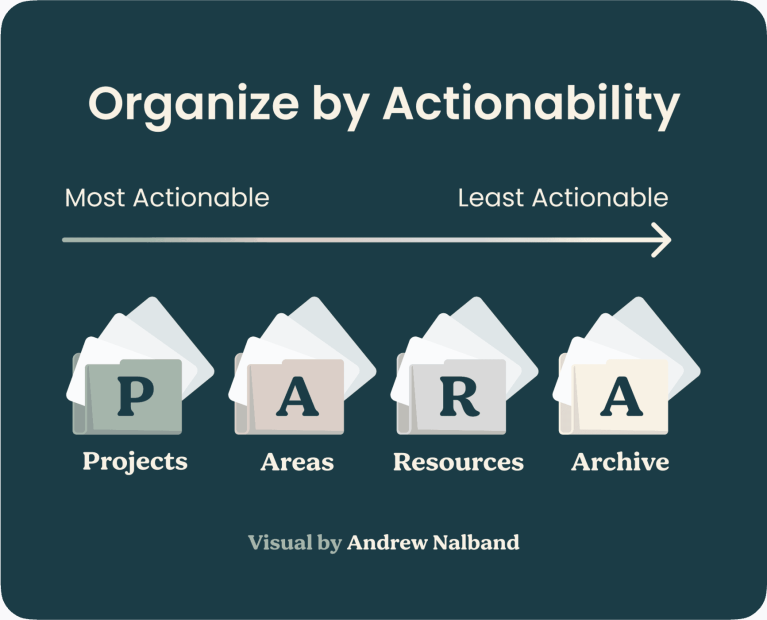
I’m also researching on similar topic and just came across another method PARA.
check fortelabs blog for more detail explanation.
- Projects : short-term efforts (in your work or personal life) that you take on with a certain goal in mind
- Areas : Long-term responsibilities you want to manage over time
- Resources : Topics or interests that may be useful in the future
- Archive : Inactive items from the other 3 categories
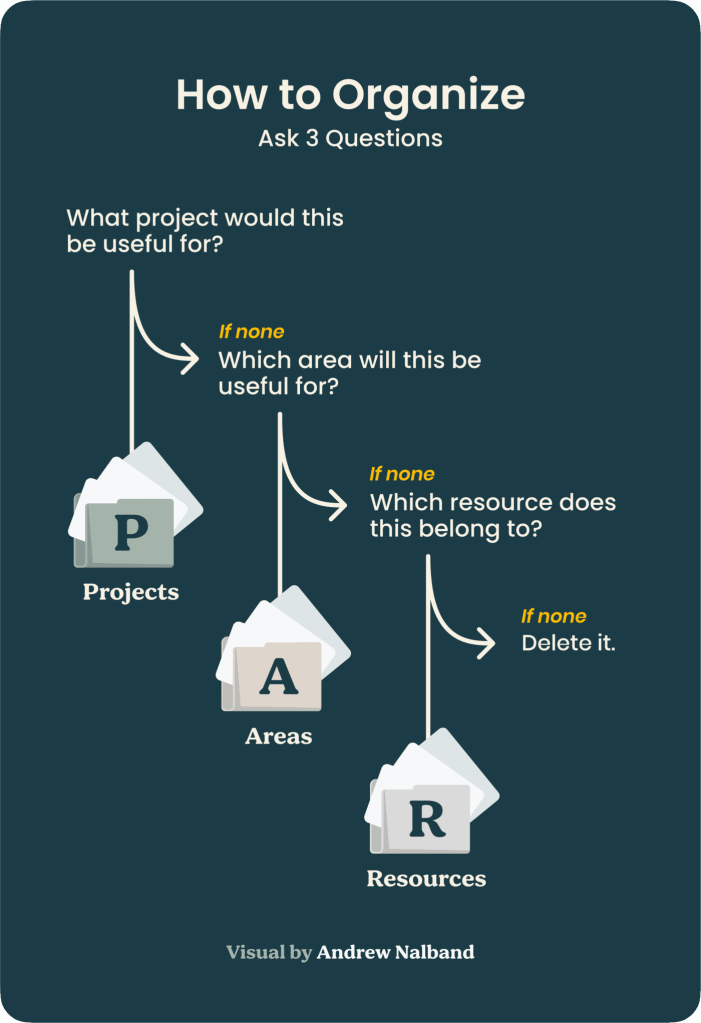
Ask yourself the following three questions to consider in which project, area, or resource a given piece of information will be most relevant and useful.
- What project would this be useful?
- If none: Which area will this be useful for?
- If none: Which resource does this belong to?
- If none, it’s probably best to archive this information or not save it at all.
It’s been a while since I’ve been to the uni or any other formal education but I do online courses every now and then and here’s my current model.
Let’s say I start watching Stanford’s Human Behavioral Biology course and want to make notes about it.
I would create a note for the course: “Human Behavioral Biology, Stanford” (let’s call this a COURSE NOTE) as a starting point. In it, I’d write down any important meta stuff like the name of the lecturer, potentially pull up a course description and syllabus and so on and I’d add links to the playlist and gather links to any other direct course-related resources.
For each lecture, I would create another note, let’s say “Introduction to Human Behavioral Biology” (let’s call this a LECTURE NOTE) and cross-link it with the course note. In the course note, I’d start with a subheading “Lectures” and make it a list that links to the lecture specific notes.
While I’m watching the lecture, I make quick notes into the lecture note about what interested me. A timestamp on the video and a quick reminder what it was about. (This is similar to how I make notes about books I read as well, btw.) After I finish the lecture, I let it simmer for a while, at least over night before I come back to it. That helps me think and process what I heard and reflect on what interested me.
On the second round, I will then return to the note and go through my timestamps and re-listen to them and expand on my notes. If any resources like books or articles are mentioned, I gather those into the note and mark them next to the topics they touch on.
When I’m done with this round of processing, likely individual topics or pieces of knowledge appear and I move them into their own notes (let’s call these TOPIC NOTES) and add links to those into the course note. The main idea for me is that I wouldn’t have to really ever return to the course or lecture note after I’m done, unless I specifically want to check something about that course itself.
When I want to check what I have about a topic, let’s say how humans recognise their relatives, I don’t need to know where I learned it to look it up. I would search for a topic note about that in my notes and through a backlink get a reminder that this course or lecture was the source I learned it from so I can check if there’s more that I’ve missed.
It also allows me to add new knowledge from other sources into the main note: maybe I read an interesting article or a book or listen to a podcast. They get their own note and then get linked to from the topic note.
What I like about this structure is that I don’t have to worry or think about the topic notes when I start learning. I can go through the course and only make my notes in the lecture notes and if I’m pressed on time, read through that when I need to prep for an exam or just check what I learned. I can do the processing part separately later.
It takes away the stress of trying to figure out what’s important and where it should live in the notes before I have the big picture of the entire course.