Another analogy can be made to the command query responsibility segregation (CQRS) pattern: one of the reasons that we’re adding and maintaining MOCs is to support future exploration. The way we get ideas in (e.g. through evergreen notes) can be different from the way that we get ideas out (e.g. through MOCs).
2 Likes
Was thinking late last night about these Map of Contents that I have been reading about as a way to organize my notes. The analogy of Congress came to my mind. Specifically, each Congress Person is a “note.” And each Congress Person belongs to a whole slew of caucases (i.e. MOCs). They belong to their:
- State
- Political Party
- Various interest groups
- Regional interests
- Ethnic affiliations
- Gender associations
- Congressional Committees
- Religious/Non Religious Affiliations
- And how many more ways to cut and dice them?
- But the idea is, that these “identies” or “affiliations” of the individual Congress Persons overlap and give multiple perspectives to each of the individual Congress Persons or “notes” in the same way that MOCs can be structured in the Obsidian database. In other words, each Congress Person belongs to multiple “caucauses” or “MOCs”.
- So my next question is, just how do I structure the syntax of both the individual Congress Person’s “note” and the various MOC notes to intuitively move back and forth between and among them all? Is a MOC in essence a pre-defined filter? Or does my analogy just confuse me with my emerging understanding?
5 Likes
No, that could work.
Say you have a Ryan J. A. Murphy person. In the Ryan J. A. Murphy note, you’d add the caucuses they’re a member of:
# Ryan J. A. Murphy

Caucuses: [[Technology and Communications]], [[Research and Higher Education]]
You could qualify/describe those caucuses in the note as much or as little as you want.
Then, in a [[Technology and Communications]] note, you might mention who the members have been at given points in time.
# Technology and Communications
## 2019-2020
The caucus has prioritized rural Internet access this year while maintaining net neutrality.
### Members:
[[Ryan J. A. Murphy]], [[kdjamesrd]]
The person note includes a linked directory of the caucuses they’re involved in, and the caucus note becomes a linked directory of the members that have been involved in it.
This example is a little contrived, though, because without note “data” (e.g., what you’d actually be writing about in the note!) it looks like a spreadsheet or database software’s a better fit for this data. The real value of the MoC concept is that you can map and direct yourself towards linked notes in-line with descriptive, qualitative information about the concept at hand. Structure and content are provided simultaneously.
2 Likes
Copying and Pasting from my thoughts initially posted in Knowledge management on Discord.
In response to @nickmilo 's question:
I keep asking for the community to think of good metaphors that cover the three parts: (1) curating the relevant notes into one place, (2) working on them: rearranging/merging/deleting/adding/etc (my favorite part), and finally (3) having that map act as a summation of thought (which should continue to evolve into the future)
A Metaphor: Notes as a Train…
They’re like a train. People all get on the train at some point. At stop one the first passengers (ideas) get on board. More get added at each stop. Some get off. All the passengers are on the train at some point. Sometimes passengers have a reserved seat. Sometimes there is only two people on the entire train. Sometimes it’s packed and people have to sit on the floor. Even if you have a reserved seat you aren’t obligated to sit in that seat. You can sit somewhere else. You can give up your seat to someone else. You can move between carriages. You can get off three stops earlier than you intended, or if you’re sneaky, you can hide in the bathroom and stay on three stops longer. The train has a destination, but it also has many destinations. The train never has a final destination because when it reaches the end, it will likely wait for more passengers and then head back the way it came. With new passengers. Or perhaps old passengers, returning from their day trip. Or maybe the train is designated an entirely new route. Maybe it’s picked up off the tracks and dropped and plonked onto a new route. Maybe it’s getting old and is taken out of commission so it goes into the train museum. When the train is on the route, the tracks can always change. It may be stalled and have to sit stagnant and waiting for go ahead.
The passengers have to sit and busy themselves with the idle time. Maybe someone hits the wrong lever and the tracks change and instead of ending up at Brighton, then end up in Grand Central Station. There are all sorts of trains. There are steam trains, and their are high-speed trains, there are double-Decker trains, there is the orient express and there is the train that runs only once a week between two small villages. There is the train that goes underground and crosses an ocean. Every passenger whilst on the train is heading somewhere, but wherever they end up also isn’t their final destination. They may get off at stop three, but they don’t sit at stop three’s train station all day. They go elsewhere. You can speak to your neighbour or you can put in your headphones. You can observe the family sitting a few seats down from you. You can stare out of the window. A train has a map that it follows, but there are many many maps. But all train tracks will in some way or other be connected with all other tracks. Just as all roads lead to Rome, and all rivers lead to the ocean. A train can be a single carriage, or it can be one hundred long. A train can be de-couple or coupled up or quadrupled up. People can jump on board without a ticket. There are conductors that check the tickets and make sure everyone is actually supposed to be there. But they can also make exceptions if they’re feeling particularly kindly.
There was also something about it being a playground, or a painters easel or a whiteboard, but I’m not sure. (You have an easel or a white board, and you can have lists, but you can also wipe them out at will). All your tools are sitting in the little tray attached to the board or easel, but you can always swap out the tools that you use.
I think a map can be a little too definitive. Sometimes a map lasts a thousand years, and yes, maps have to be updated to stay relevant, but I feel the initial idea of a map tends to be a little more fixed. Unless you mean a map as in say, Google Maps, where the map is everywhere, the terrain, the atlas, if you will, and the route that you punch in is the your notes and ideas, and sometimes you have regular routes, like to work, or the supermarket. But sometimes you go to a new shop, or you change job, and you have to put a new route into the map. Map for me conjures up a pirate’s map, a map to x marks the spot, and whilst it could be said that you don’t have to follow a map to a T, you usually are quite passive when following a map. You’re looking at it expecting it to take you to the X, but you usually know what the X is, because that’s why you picked up the map in the first place (or that’s why you started to draw your own map to get there).
Also I’d add that, to bolster the thinking factor, people get inspired when they’re on a train. They’re planning what they’re going to do when they get to their destination. Or they get inspired to start planning another trip entirely. Or they’re just busy thinking about that stupid conference call they have to get on later, or that they forgot to pick up this ingredients for lasagna. But all these people have their own webs, their own lives, even whilst they all sit in the same carriage. There is the world beneath, and then there is the carriage itself, the train itself. The MOC is the train. The notes are the passengers. Or something like that.
10 Likes
@masonlr Good thinking here. If this is helpful for your synthesizing, perhaps a helpful way of considering MOCs is through emergence.
MOCs are Evergreen Notes, just at the next level of emergence.
2 Likes
I agree that filing you in the 80s folder would be the wrong place to start, but filing you in the People folder would be perfectly rational. Linking you to your hobbies and likes/dislikes would be a reasonable choice.
@ja_rule Returning to this notion of “base objects”, I’m currently using a few base object / resource folders and haven’t ran into any issues yet: Images, People, Quotes, and Source Materials (things written by other people). I don’t have to use these folders; I could easily add their contents into the main vault; but I slightly prefer keeping them slightly more tidy. I like your description of base objects, thanks.
2 Likes
Yes to this! The analogy of notes as people is a strong one. As is the caucus. I’ll add that the purpose of an MOC is to have a sort of evergreen, ongoing, caucus.
In an MOC, the party is always happening. Individual notes can “shadow-clone” themselves and essentially be in multiple parties simultaneous—interacting and developing complexity from each party at the same time!
1 Like
I may give this folder structure a try. I’ve been using tags and links more for finding things and currently use folders for Types of notes, but I’m not happy with it in some ways. However, the advantage to using Folders in Obsidian is that we can start typing for a link and it will include the folder, giving you an idea of it is a Project, Idea, Meeting note, etc. What I don’t like is deciding which folder to put things in. I tend to add more folders than I need and always have to cut back.
I’m now almost 2 months into Obsidian use, and I’ll say that I’m reasonably happy with where I landed, with slight modifications. As I noted somewhere up-thread, I’ve taken a hybrid approach, with relatively few base folders, and most of my notes going into date-based buckets. So I have a top-level 2020 folder, and in this an 06 folder for June, an 07 folder for July, etc. The main change I’ve made is that each new note starts with a DD designation for the day followed by a short, descriptive name. So notes created today would look like “15 My awesome thoughts on PKM”, where previously I hadn’t prepended the DD. I found a bucket full of alphabetically sorted notes less helpful than date sorted. My daily notes get just the DD, with no label. This naturally sorts everything in the File Explorer by date, which is great, and is perhaps my compromise with the hardcore Zettlekasten folks who prefer the 20200715104223 type identifiers. I average 3-4 notes a day including the daily note, so at the end of the month I’ve got 90-120 files in my monthly folder, which is a manageable chunk size for me. The daily notes, with their very short DD name, make it visually easy to scroll through the list, since the extra blank space breaks things up by day, and it’s oddly satisfying to open a new month with a fresh folder. For me, remembering roughly when I was thinking about something is a useful axis for recall.
I try to make everything a regular note, meaning it just goes into the date based hierarchy with the above naming scheme. I’ve also had a [small] bit of stress over the decision of “should this be a base note or go in the date bucket”, and try to just put stuff in the bucket, but be sure to link it somewhere. Topics will naturally bubble up that want to have a MOC to link them together, so I add them when I feel it’s necessary.
2 Likes
I’m starting from 0 with Obsidian and spent a decent amount of time last week reading interesting lines in this forum. This post really clarified many assumptions I’ve made and the approach I’d like to implement and leverage within my personal PKM.
I’m definitely leaning towards a radical flat approach based on “as atomistic notes as possible”. There is something which however is still now working in my mental model and I’m still pretty confused about… notes titles.
In principle, I’m leaning towards not giving notes titles and just navigating notes through backlinks and graphs. Reasons:
- Note titles seem an unnecessary layer and a first, altough inherently preclusive, attempt to classify a body of information/knowledge which I want to develop differently. I’d like the system to supports my thinking at higher levels of abstractions and spur unexpected connections rather than labeling and siloing things.
- Considering that I want to take super atomistic notes, in many cases, the title would just be a repetition of the note body.
The question is, would this approach be viable at all or is just supported by my current limited understanding of the topic? Would really appreciate if you can share your thinking.
To let you better understand what I’m trying to achieve, you should know that my use case revolves around:
- Consolidating professional knowledge scattered around years of folder based reading and note taking
- Develop knowledge in a variety of personal interests
Also, haven’t checked yet evergreen notes and the maps of content which seems pretty crucial concept to develop the PKM along the lines I’m foreseeing.
Finally, could you suggest some intro reading (but not too basic) about
ingormation modelling?
1 Like
I can see the argument for not titling. For me, titles are kinds of cognitive landmarks—when I read a title I can generally remember-imagine what’s in the note. I think that’s useful, but I’ve never tested the alternative. It might be worth trying it out—give yourself a week, leave titles off, and see how it feels.
I will have to get back to you on some readings on information systems/conceptual modeling. One of the gaps in the field is knowledge translation—that is, providing practical insights based on the theory. A lot of what has been done is focused on conventional databases and design for major organizational use, not individualized PKM as we’re discussing. So there might not be much on it as yet! I’ll have a look, though.
@paoloap Andy mentioned that Evergreen note titles are like APIs. The titles become abstractions for the notes itself, and an entire note can be referenced using the title.
APIs is a crucial component to effective high-level programming (higher abstraction level of thinking), since we are reusing fine-grained (atomic) abstractions (note titles). Using this analogy, there are several principles of API design that we can apply to the note title design (separation of concerns, etc). Over time, as our ideas mature, we go back and refactor the APIs (refactor note title and its content) to achieve a higher level of atomicity.
I think that’s one of the arguments for note titles. Personally I employ this approach. My note titles often start out as in-the-moment-conceptualization, and as I revisit them within a day or two I often reflect better and refactor the note titles to something more representative of the notes’ ideas
8 Likes
On a more practical level, how do you link to a note that has no title?
1 Like
IMO that is the crux. As with a book, or any document that carries a title, the title is the ultimate, super-concise summary of it. Like you, that’s how I see and use titles.
1 Like
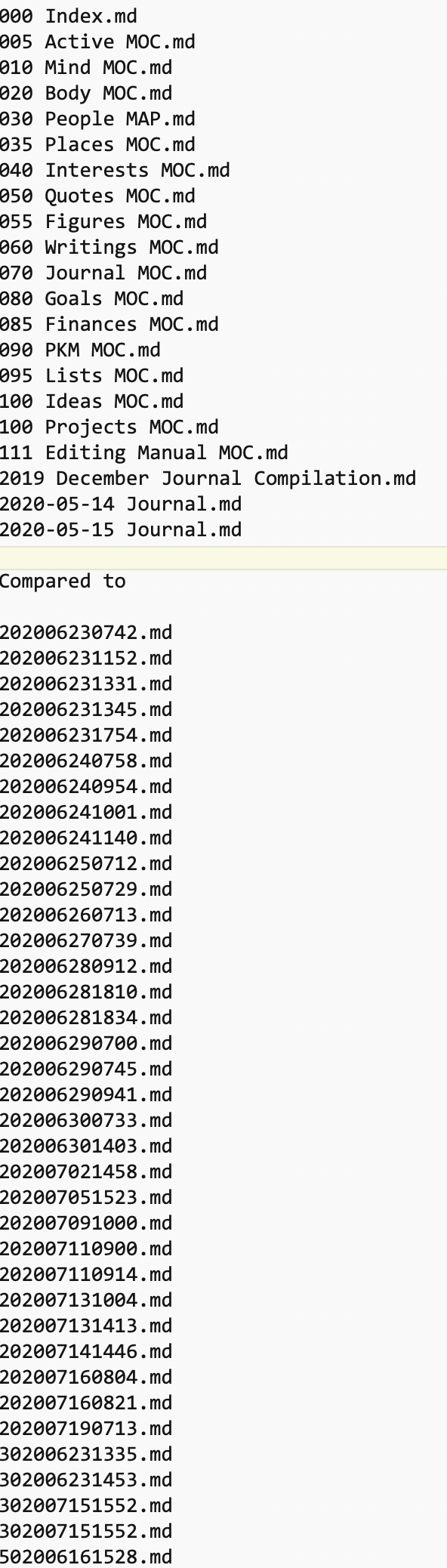
At least some sort of slug in the file name gives a hint, 202007190807 Recipe - Grilled Red Snapper as opposed to just 202007190807 lets you look at files in a directory and have some clue. Even if the slug you use in the filename isn’t perfect, it is something.
Suppose five years from now you have 10,000 notes. Just looking at the folder of files with only numbers as filenames would kind of look like a black hole.
I doubt you would ever regret using some sort of slug in the filename. You might if you ever need to look into that black hole.
Filenames like these below at least give you the top entry points into your network of notes from a folder of files on the file system:
3 Likes
thanks for sharing, conventional db design and organizational applications would be super interesting to explore as well
Thanks for the pointer and for sharing your personal approach Andy was already in my reading list, will delve into it.
Revisiting note titles after a couple of days seems an excellent technique to refine notes conceptualization and enhancing future applicability.
1 Like
thanks for sharing, conventional db design and organizational applications would be super interesting to explore as well
Your reply should have gone to @ryanjamurphy.
Well, here’s a quick one: On Information Quality. It’s kinda tangential, but I think it gets at concepts fundamental to these discussions. It defines what information quality is and how it can be improved.
And a second, on the fundamental cognitive challenges of classifying information in databases: Using Cognitive Principles to Guide Classification in Information Modelling.
10 Likes
Well said, I agree and follow the same process.