Dashy: dashboards for your notes, written in YAML

Disclaimer

Is this plugin open source? Yes
Is this plugin completely free? Yes
Is this plugin vibe-coded beyond the author’s ability to comprehend how it works? No
Community Directory: Link

MIT licensed, 490 tests, 96% of statements covered. The catalogue’s build check reproduces the released main.js byte for byte.

Dashy: dashboards for your notes, written in YAML

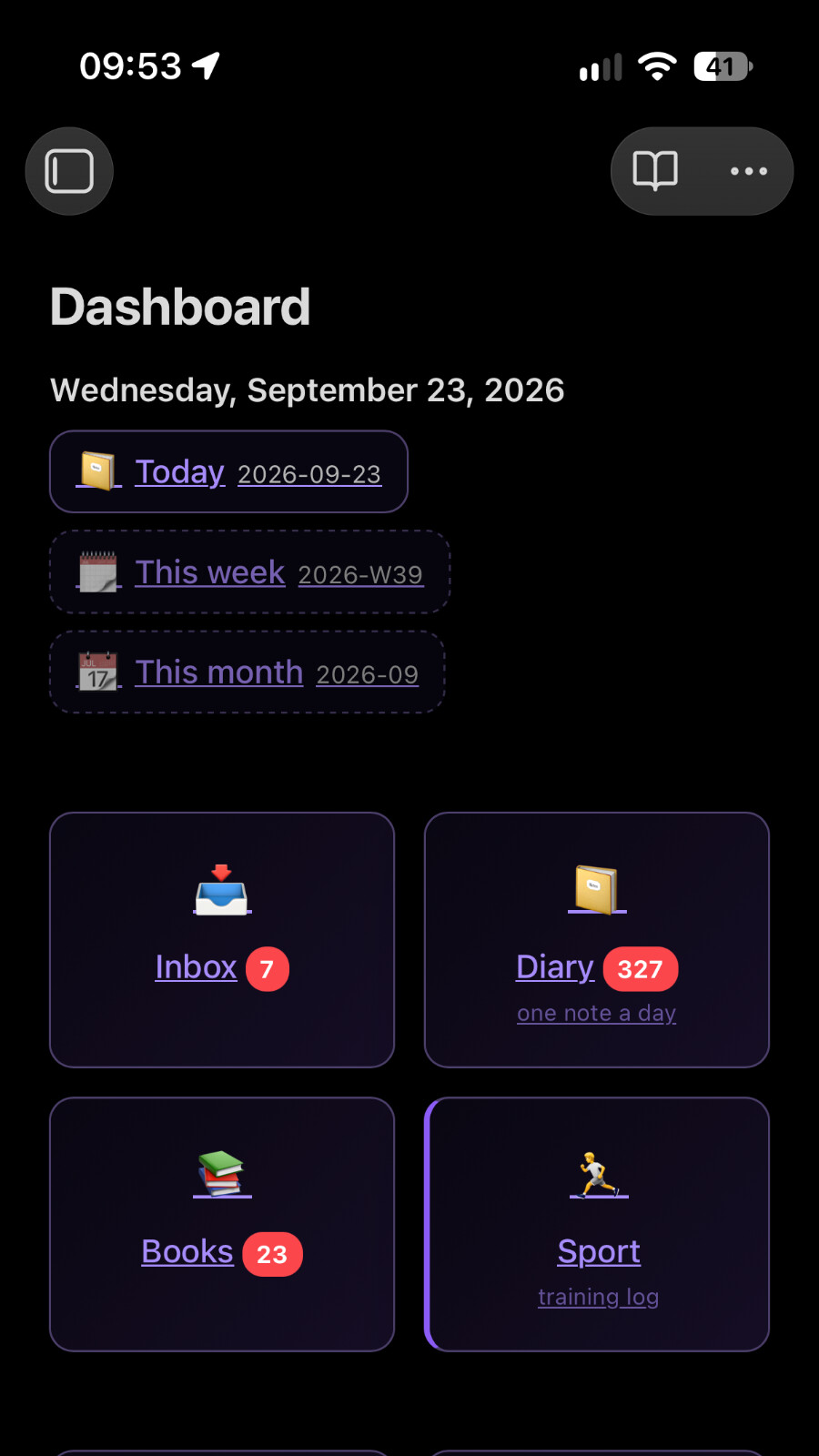
You write a fenced block, you get a dashboard. Six of them: navigation tiles with live folder counts, number cards with sparklines, progress bars towards a goal, a row of links to today’s periodic notes, countdowns, and a year heatmap.

Why I built it

My daily notes carry numbers: steps, sleep score, kilometres. They sat in frontmatter for two years and I never looked at them, because looking meant writing a query first. I wanted the front page of my vault to show me how the year is going, in five lines I could still read a month later.

A word on scope. Dataview is a query language with real power behind it and I use it myself. Dashy sits at the other end: six fixed blocks, a handful of keys each, no query language and no JavaScript. If you need a join or a computed column, that is Dataview’s job. If you want a card that counts the notes in a folder, this is lighter.

There is a second reason, and it is the one I did not expect to matter most. A block is YAML with a schema, so an agent can write one for you. Dashy ships a reference generated from that schema: SKILL.md for Claude Code, a fenced section in AGENTS.md for everything else. You describe the dashboard you want, the agent writes the block, and the block either renders or says which key it did not understand.

Key features

  • Six blocks: tiles, stats, progress, today, countdown, heatmap. A few lines of YAML each, inside a fenced code block.
  • No JavaScript, no Dataview. Numbers come from Obsidian’s own metadata cache.
  • Live. Add or edit a note and every block on the page follows.
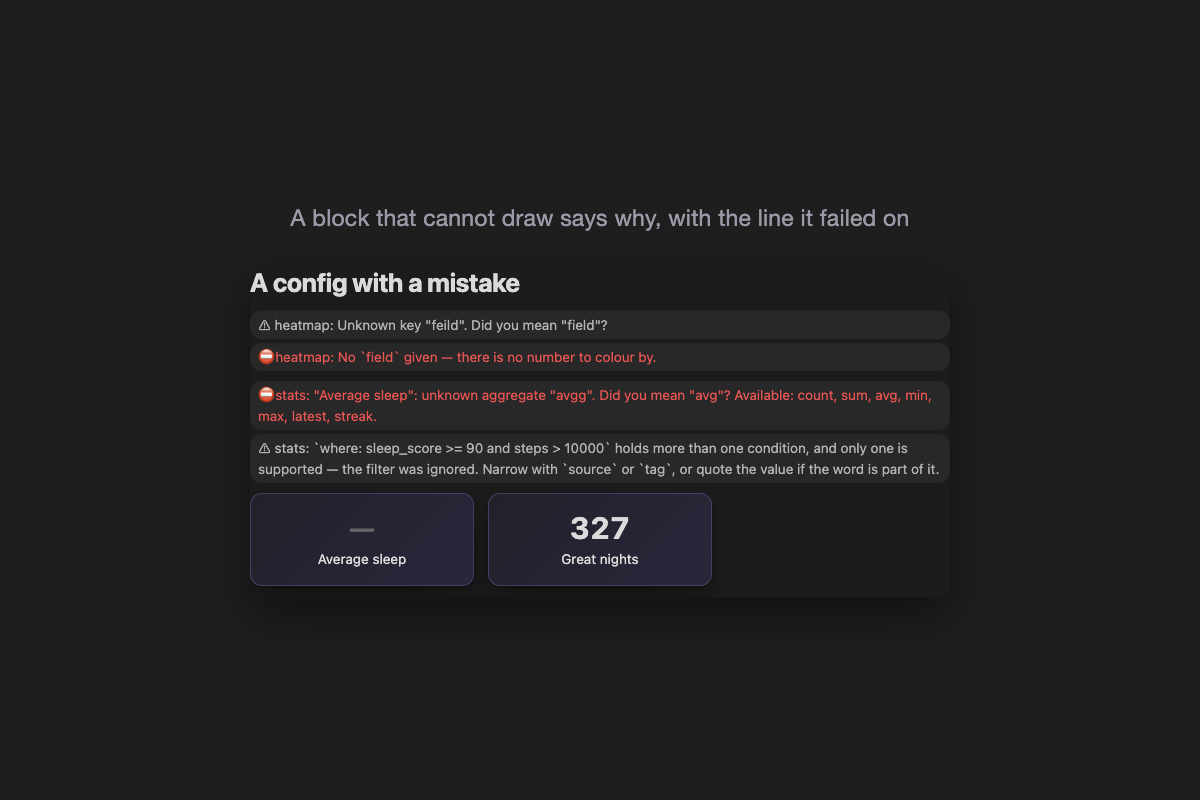
  • Errors land in the note. An unknown key gets a line number and a suggestion, instead of a block that quietly shows zero.
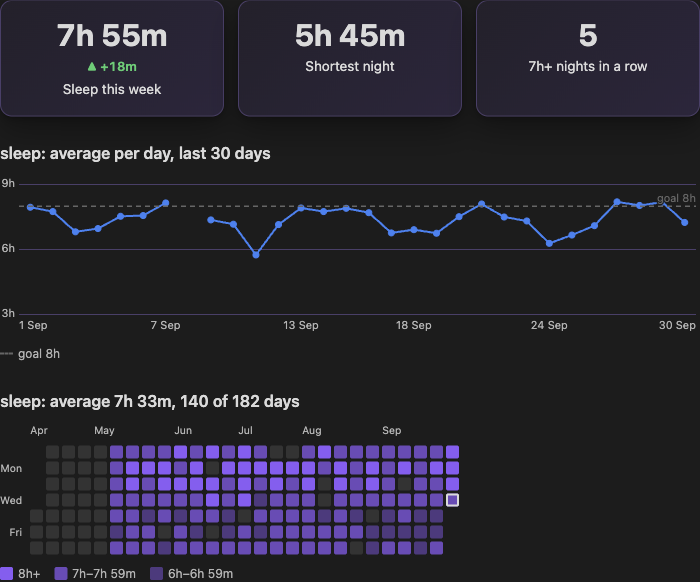
  • Sparklines: trend: 30d draws the last thirty days beside the number.
  • Five languages: English, Russian, German, French and Spanish, following Obsidian or a setting of its own. Dates, month names and the first day of the week come from Obsidian, so they are right everywhere.
  • Colours come from your theme. The stylesheet holds no fixed colour at all.
  • Desktop and mobile.

The same dashboard in a light theme, a block explaining what it could not read, and the whole thing on a phone:

How to install

Settings, Community plugins, Browse, then search for “Dashy”. Needs Obsidian 1.13.0 or newer.

Links

Community directory: Dashy - Obsidian Plugin
GitHub: GitHub - Dimagious/dashsidian: Dashboard blocks for your notes: tiles, number cards, progress bars, a day row, countdowns and a year heatmap. Configured in YAML, no JavaScript. · GitHub

If you try it, tell me which block you reached for first, and which one you wanted and did not find. The German, French and Spanish wording is mine and unchecked by anyone who speaks them properly, so corrections are welcome: one file, one pull request. Bug reports go through Settings, About, Report a bug, which fills your versions in for you, or straight to GitHub issues.
Dashy 1.2.0: a habit tracker from daily note checkboxes

After the first release I read through this forum to see what people build dashboards for. One request came up more than any other: a habit tracker from daily notes, without learning Dataview or JavaScript. Achieving habit tracker with obsidian? has 15k views, and its author offered $5 a month for a setup. The Heatmap Calendar thread is full of DataviewJS queries that broke.

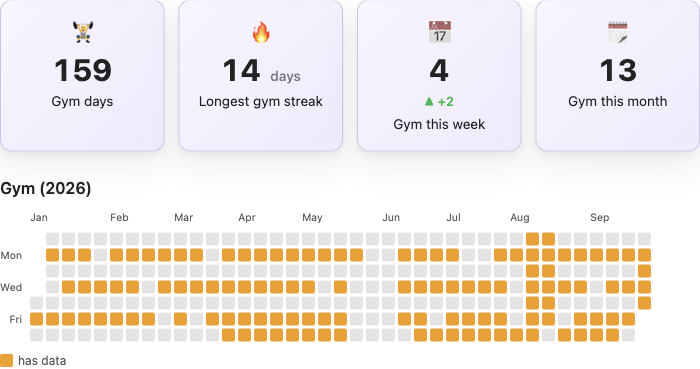
So in 1.2.0 a Properties checkbox counts. gym: true in a daily note is 1, an unticked box is 0, and this is the whole config:

```stats
columns: 3
items:
  - { label: Gym days, source: Diary, field: gym, agg: sum }
  - { label: Longest streak, source: Diary, field: gym, agg: streak, unit: days }
  - { label: Gym this week, source: Diary, field: gym, agg: sum, period: week, compare: true, better: up }
```

```heatmap
source: Diary
field: gym
```

What else is in 1.2.0:

  • period: week, month, year or 30d on stats and progress. “Books this year” used to be where: "year = 2026", which quietly went wrong on 1 January. A period counts from today. Notes without a date in the name can take one from a property: date_field: finished.
  • compare: true sets this week against the same days of last week, Monday to Thursday against Monday to Thursday, so a card doesn’t show a drop every Monday. The colour stays neutral unless you say which way is good: better: up or better: down.
  • Fixes. A long number on a card no longer wraps in the middle of its digits. On a phone, a heatmap too wide for the screen fades at the edge that still has weeks behind it. It also opens on the latest day now: that was meant to work since 1.1 and never did.

To update, go to Community plugins → Check for updates. To install, search for Dashy.

If you track something this doesn’t cover, a mood score, pages read, anything, post it here. I pick the next release from this thread.

Dashy 1.5.0: charts from your daily notes

The request I kept finding after 1.2.0 was a chart: kilometres per week, sleep over the last month, a line with a goal on it. Today that usually means a dataviewjs script feeding Obsidian Charts, or Tracker, where summing by week is still an open request.

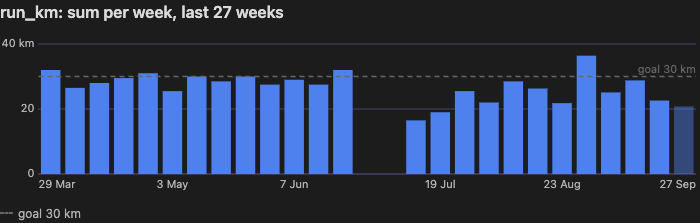
1.5.0 adds a seventh block, chart. Weekly running distance against a goal is the whole config:

```chart
source: Diary
field: run_km
type: bar
bucket: week
unit: km
goal: 30
```

Weeks you didn’t run stay on the axis as a gap, and Dashy draws the week in progress lighter, so a Monday doesn’t look like a collapse. bucket can be day, week or month, and series takes up to four fields on one chart.

Sleep was the other half of the request, and trackers write it as text: 5h 58min, 7:30. Dashy reads those as numbers now and shows them back in hours and minutes:

```stats
columns: 3
items:
  - { label: Sleep this week, source: Diary, field: sleep, agg: avg, period: week, compare: true, better: up }
  - { label: 7h+ nights in a row, source: Diary, field: sleep, agg: current_streak, at_least: 7h }
  - { label: Meditation days in a row, source: Diary, field: meditate, agg: current_streak }
```

```chart
source: Diary
field: sleep
agg: avg
goal: 8h
```

What else is in 1.5.0:

  • current_streak, the run you’re on today. streak was only ever the best run on record. Today doesn’t break it until the day is over, so a morning before you’ve logged anything still shows yesterday’s count.
  • where takes several conditions, as a list or joined with and: where: "year = 2026 and rating >= 4". or still isn’t supported, and it says so instead of counting nothing.
  • Clearer errors. layers: in a chart points you at series:, and a warning names the key you typed, not the one a synonym turned it into.

To update, go to Community plugins → Check for updates. To install, search for Dashy.

If you chart something in Tracker or Charts that this can’t do yet, post it here. The next release comes from this thread again.

Dashy 1.5.2: works next to Obsidian Charts, plus guides and a key reference

If you run Obsidian Charts, 1.5.0 and 1.5.1 had a bug for you. Both plugins answer to the chart code block, and whichever loaded second lost it. In 1.5.1 that could still be Charts: “Failed to load plugin”, and your Charts blocks drawn by Dashy with warnings. Sorry about that.

In 1.5.2 Dashy leaves chart to Charts whenever Charts is on. Write Dashy’s charts as dashy-chart; the keys are the same, and Insert block pastes it that way. The example in my 1.5.0 post above becomes:

```dashy-chart
source: Diary
field: run_km
type: bar
bucket: week
unit: km
goal: 30
```

If you switch Charts on while Obsidian is open, restart Obsidian once.

Two new things on the site:

  • Four step-by-step guides, each with the note, the blocks to paste, and the same result in Tracker and dataviewjs: Guides · Dashy
  • A reference with every key of every block, its default and its synonyms, one page per block: Block reference · Dashy

The README shrank from 729 lines to about 170 because of it; the key tables live on the site now.

Dashy 2.1.0: weekly and monthly review notes

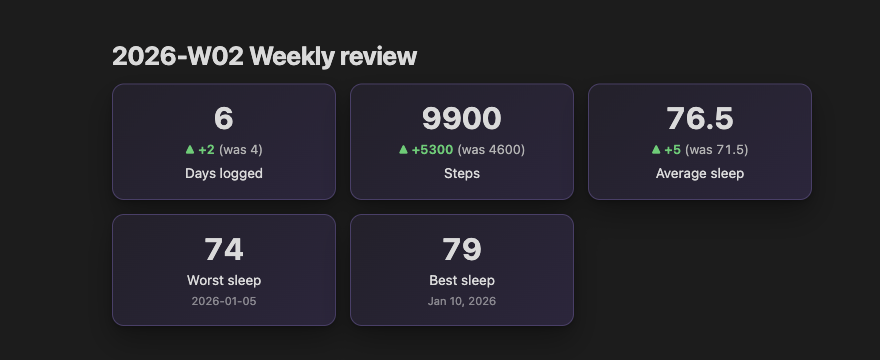
A note named 2026-W02 Weekly review, one block. Each card compares with the week before, (was 4), and the bottom two say where the value came from:

columns: 3
source: Diary
period: note
items:
  - { label: Days logged, agg: count, compare: true, better: up }
  - { label: Steps, field: steps, agg: sum, compare: true, better: up }
  - { label: Average sleep, field: sleep_score, agg: avg, compare: true, better: up }
  - { label: Worst sleep, field: sleep_score, agg: min, origin: note }
  - { label: Best sleep, field: sleep_score, agg: max, origin: date }

What’s new:

  • period: note reads a name with words after the period: 2026-W41 Weekly, 2026-10 Monthly Review, 2026-Q4 review. A bare 2026 goals is still not a year review.
  • compare: true shows last period’s value next to the delta.
  • origin: note names the note a record came from, origin: date shows its date.
  • field takes a list, so one card sums several properties: field: [run_min, bike_min].
  • where: "date empty" finds notes that lack a property.

Two commands help an agent: Dashy: Write vault profile (.dashy/vault-profile.md) and Dashy: Check blocks in this note (.dashy/block-check.md). They write only when you run them, and no note text goes into either file.

Also fixed: a review template no longer shows an error for a name that is no period, and columns: 1 stays one column on a phone.

Full list: dashsidian/CHANGELOG.md at master · Dimagious/dashsidian · GitHub

I’m the developer. If your agent gets a block wrong, paste the request and the error the block shows.